It Starts in Your Legs
Some students believe that improving a standing twist simply means turning further. In reality, the quality of the twist depends on everything that happens before the rotation begins.
When the legs are not fully engaged or the pelvis loses stability, the front body shortens, the chest collapses, and the twist becomes compressed rather than expansive.
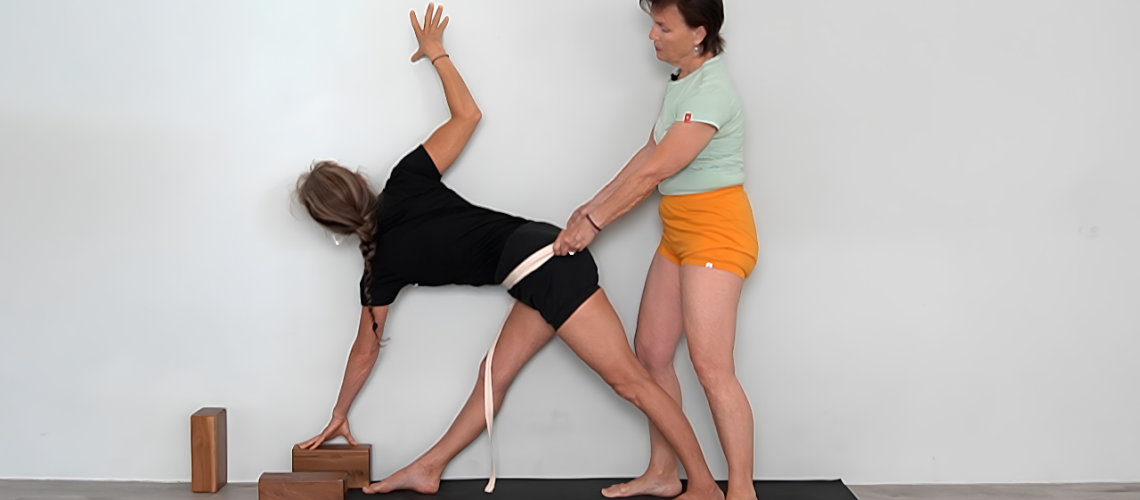
In this lesson, Kathy Cook demonstrates how creating length first changes the entire pose. By grounding through both feet, organizing the pelvis, and extending the spine before rotating, the twist becomes lighter, steadier, and more spacious.
Props such as blocks, walls, and straps are used not as shortcuts, but as valuable feedback. They help maintain the relationship between the legs, pelvis, and spine while allowing the chest to rotate with greater freedom.
One of the most valuable reminders from this practice is that a twist is never static. Even after arriving in the pose, you continue to lengthen and subtly refine the rotation from within.
When the foundation is stable, the twist becomes an expression of extension rather than effort.