A Quieting Practice
Emotional stability does not necessarily come from trying to make the mind quiet. Sometimes we first need to create the physical conditions that allow quietness to arise.
In this slower Iyengar Yoga practice, we use support, alignment, inversions, forward bends, twists, and restorative poses to observe the relationship between the body, breath, senses, and mind.
Supporting the head
One of the recurring elements throughout this sequence is support for the head.
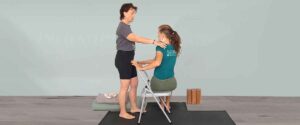
When the head is properly supported, unnecessary effort in the neck, face, and eyes can begin to release. In forward bends, for example, the forehead rests on a blanket, bolster, arms, or chair rather than hanging unsupported.
But the support has to be appropriate. If the head is too low, the face may become compressed. If the head is positioned so that the chin and eyes lift upward, the mind may remain more active.
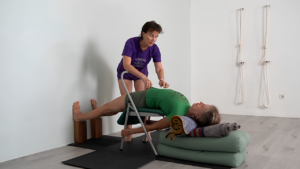
This becomes particularly important in Savasana. We arrange the support so that the forehead is slightly higher than the chin. The eyes can then soften and descend rather than continually being drawn upward and outward.
Stability before relaxation
A quiet practice does not mean that the entire body becomes passive.
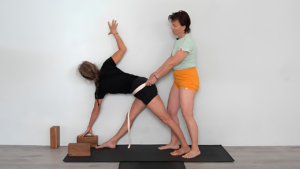
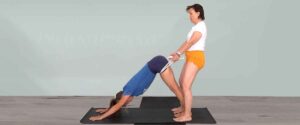
In supported standing forward bends and inversions, the legs continue to work. The feet remain grounded, the kneecaps lift, and the thighs move in their appropriate direction. The shoulders and arms also maintain actions that create length through the trunk.
This stability allows other areas to release.
Rather than collapsing into a pose in an attempt to relax, we establish the necessary actions and then observe what can become quiet.
Creating space for the breath
Support for the chest is another important part of the sequence.
In Supta Baddha Konasana, for example, the bolster supports and lifts the chest while the neck and head are carefully arranged. The back ribs have space, the chest opens, and the breath can be observed without deliberately forcing it.
Elsewhere in the sequence, the relationship between the legs, pelvis, abdomen, and chest creates space through the trunk.
As Kathy explains during the practice, the breath does not need to become an active exercise. We can simply observe it becoming softer, slower, smoother, and eventually longer.
Supported inversions and emotional steadiness
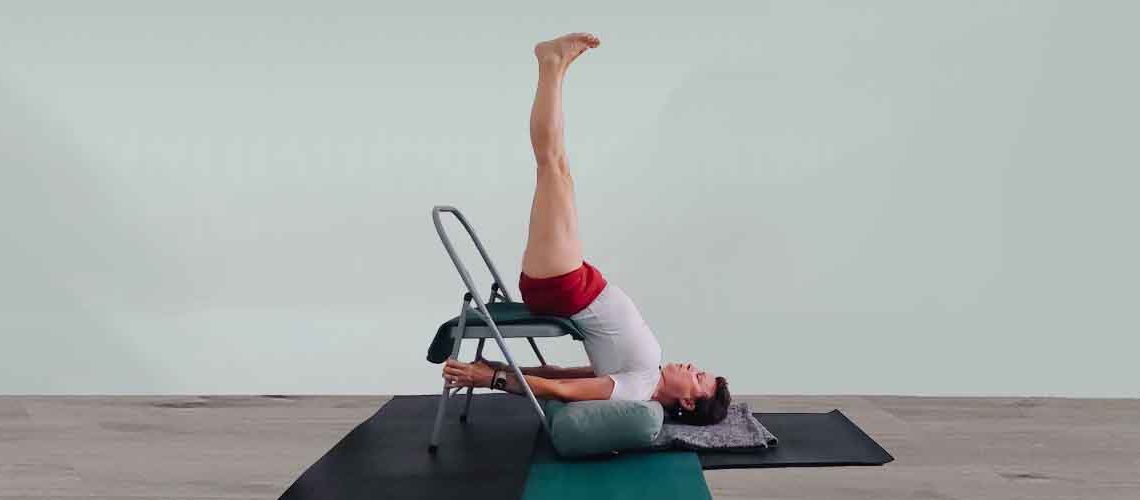
The class also includes supported Sirsasana and chair Sarvangasana.
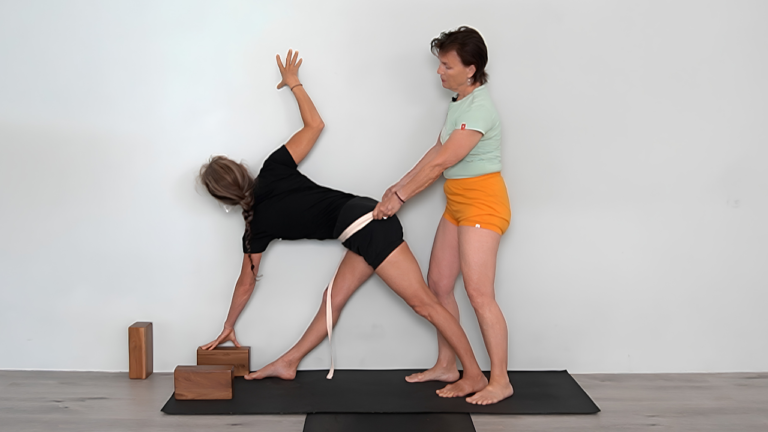
The use of the wall, chairs, blankets, and other props is not simply to make the poses easier. The support reduces uncertainty and provides physical stability.
This is especially relevant in inversions. Going upside down can initially create apprehension, particularly for someone without much experience. The purpose is not to force yourself through that response.
Instead, the pose should be arranged so that you feel sufficiently stable to observe the breath and remain attentive. If the inversion is not appropriate, a supported alternative can be used.
Turning inward
Toward the end of the sequence, the poses become increasingly quiet. Supported forward bends lead toward Savasana, where the body is carefully positioned to reduce unnecessary sensory stimulation.
This introduces the principle of pratyahara, often described as drawing the senses inward.
Our eyes, ears, tongue, skin, and other senses continually pull our attention toward the external world. In a quiet practice, we begin to reduce that outward movement.
The eyes soften. The breath settles. The body is supported enough that it no longer continually asks for adjustment.
Attention can gradually turn inward.
This is one of the valuable lessons of a restorative Iyengar Yoga practice: emotional quietness is not created by simply telling ourselves to relax. Through intelligent sequencing, appropriate support, and careful attention to the body and breath, we create an environment in which the mind has an opportunity to become quiet.